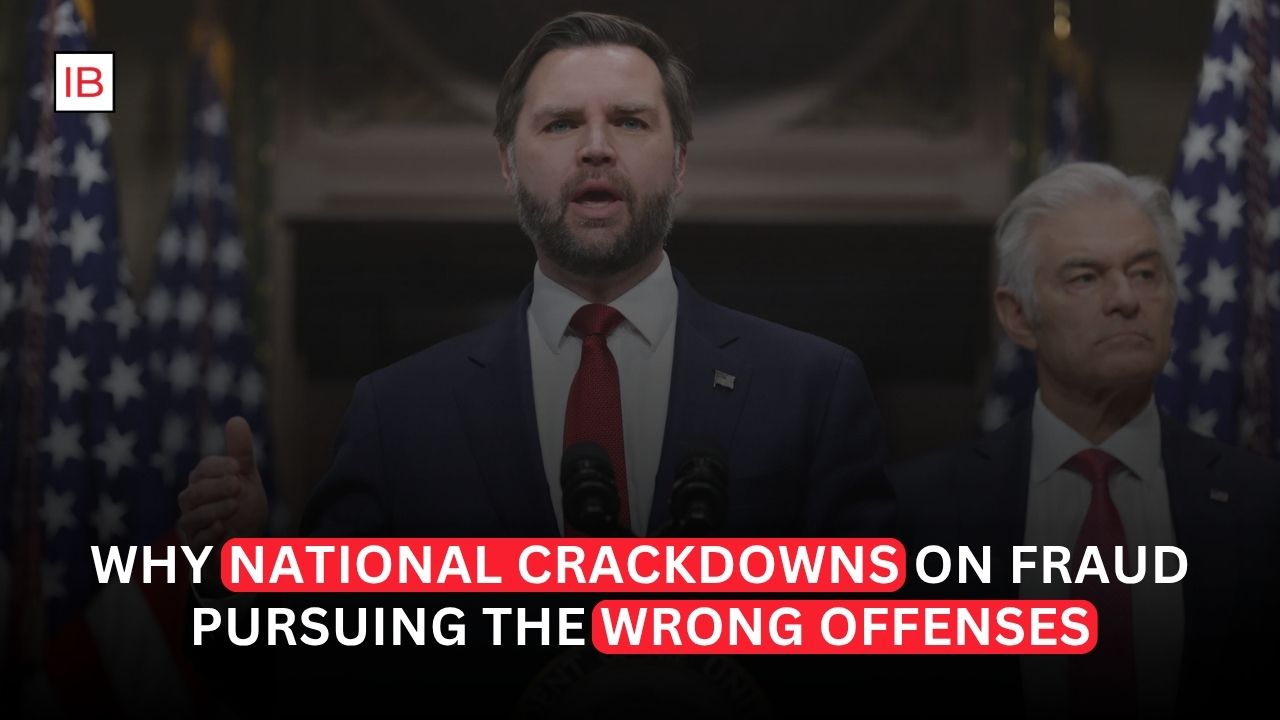
The Trump administration has made fighting fraud one of its most visible law-enforcement priorities, but the central question is whether Washington is targeting the kinds of white-collar crime that cause the greatest damage—or simply the kinds of fraud that are politically convenient.
The administration has created a new National Fraud Enforcement Division inside the Justice Department, expanded its authority and shifted substantial resources toward fraud involving taxpayer-funded programs. The division is expected to have roughly 500 prosecutors and staff, while the White House has publicly highlighted billions of dollars in alleged fraud uncovered, stopped or prosecuted.
The problem is not that government fraud should be ignored. It should not.
The problem is that an aggressive anti-fraud campaign can still be badly designed if it concentrates on visible benefit fraud while giving less attention to sophisticated financial misconduct, corporate wrongdoing and other forms of white-collar crime that can damage markets and taxpayers on a much larger scale.
A New Era of Anti-Fraud Enforcement
The administration has made fraud a major political and law-enforcement issue.
The White House says its Task Force to Eliminate Fraud has uncovered nearly $230 billion in fraud, prevented about $56 billion in fraudulent payments and enforced more than $55 billion through indictments, settlements and civil penalties.
The administration has also launched Fraud.gov as a public-facing platform for tracking enforcement actions.
The message is straightforward: Washington wants Americans to believe that the government is finally taking fraud seriously.
That is politically powerful.
Fraud costs taxpayers money, damages public confidence and can destroy vulnerable people’s savings.
But the scale of the campaign creates another question:
What exactly counts as the priority?
The Justice Department Is Changing Its Structure
The most significant development is the creation of the National Fraud Enforcement Division, or NFED.
The new division was created to focus on fraud involving taxpayer dollars and taxpayer-funded programs. It brings together personnel and responsibilities that previously sat in different parts of the Justice Department.
A final Justice Department rule published in August gives the division significant new authority.
It transfers enforcement jurisdiction in areas including healthcare and tax-related matters and gives its leadership broader power to pursue additional cases. The rule also allows the division to open special grand juries in jurisdictions across the country.
That is a major institutional change.
The question is whether concentrating so much authority around one anti-fraud operation improves enforcement—or distorts it.
Public Benefits Fraud Is Only One Part of the Problem
Healthcare fraud, benefit fraud and fraudulent government payments can be enormous.
The administration has highlighted cases involving Medicare, Medicaid, childcare programs, pandemic loans and other government-funded programs.
For example, the White House says the Justice Department charged 455 defendants across 45 states and territories in June in healthcare-fraud cases involving more than $6.5 billion in false claims.
These cases deserve attention.
But white-collar crime is much broader than fraudulent claims against government programs.
It includes:
- Securities fraud
- Insider trading
- Accounting manipulation
- Corporate bribery
- Market manipulation
- Investment fraud
- Bank fraud
- Money laundering
- Procurement corruption
- Consumer financial fraud
If enforcement becomes heavily concentrated on taxpayer-funded programs while other categories receive fewer resources, the government may end up fighting only part of the problem.
The Shift Away From Traditional White-Collar Enforcement
This is where the criticism becomes more serious.
The Justice Department has renamed its traditional Fraud Section as the White Collar and Corporate Enforcement Section, reflecting a narrower portfolio focused on private fraud enforcement such as insider trading and securities fraud.
At the same time, the new Fraud Division is becoming increasingly focused on taxpayer-funded programs.
That creates a structural separation.
Government fraud becomes the centerpiece of the new enforcement operation, while traditional corporate and financial crime remains elsewhere.
The risk is that the administration’s definition of the “fraud crisis” becomes too narrow.
Why Corporate Crime Matters
A sophisticated corporate fraud can involve thousands or millions of victims without producing the kind of obvious individual cases that attract political attention.
Consider securities fraud.
A company that misrepresents its financial position can distort the decisions of investors, lenders, employees and suppliers.
A major accounting scandal can destroy billions of dollars in market value.
Insider trading can undermine confidence in financial markets.
Bribery can distort competition and reward companies that break the rules rather than those that compete honestly.
These crimes may not generate dramatic headlines about fraudulent benefit claims, but their economic consequences can be enormous.
The Administration Has Pulled Back in Some Areas
The broader concern is not merely where new resources are going.
It is also what may be receiving less attention.
The Trump administration has reduced or reshaped some traditional white-collar enforcement priorities, while the Justice Department has reorganized its resources around the new anti-fraud structure.
The result is a rebalancing of federal enforcement.
The administration argues that the change makes government more efficient and focuses prosecutors on crimes directly affecting taxpayers.
Critics argue that it risks weakening enforcement against powerful private actors.
That disagreement is fundamental.
Fraud Against the Government Is Still Serious
There is an obvious counterargument.
Government programs involve enormous amounts of public money.
Medicare, Medicaid, disaster assistance and other programs can become attractive targets for organized fraud networks.
The White House says it has identified thousands of cases and billions of dollars in suspected fraudulent activity.
Stopping that fraud can produce immediate savings.
There is also a practical advantage.
Government payment systems generate huge amounts of data.
That makes them increasingly suitable for automated fraud detection and data analytics.
The new division says it intends to use advanced data analysis as part of a nationwide enforcement strategy.
That could make enforcement faster and more efficient.
The Real Problem Is Prioritization
The strongest criticism of the administration is therefore not that it is fighting fraud.
It is that it may be choosing fraud according to political visibility rather than economic damage.
A government can aggressively prosecute thousands of relatively small cases and still fail to deter major financial misconduct.
The number of prosecutions is not necessarily the right measure.
The important questions are:
- How much money was actually lost?
- How many people were harmed?
- Was the conduct intentional?
- Was the fraud systemic?
- Did senior executives benefit?
- Did regulators miss warning signs?
- Was the financial system itself damaged?
Those questions matter more than simply counting indictments.
Political Incentives Can Distort Enforcement
Fraud enforcement is particularly vulnerable to political incentives because it is easy to present individual cases as evidence of a broader crisis.
A spectacular fraud case can generate headlines.
A complex securities investigation may take years.
The first produces visible political rewards.
The second requires patience.
That creates a temptation for politicians to emphasize cases that fit their preferred narrative.
A genuinely effective anti-fraud strategy should resist that temptation.
Law enforcement should follow evidence rather than political popularity.
The Minnesota Factor
The administration’s anti-fraud push has also become politically connected to allegations involving Minnesota public-benefits programs.
The new Fraud Division has faced pressure to investigate Minnesota Gov. Tim Walz and Attorney General Keith Ellison over alleged failures to address systemic public-benefits fraud.
That raises another concern.
Once an anti-fraud institution becomes associated with specific political disputes, its credibility can become vulnerable.
Even legitimate investigations may be viewed through a partisan lens.
For a law-enforcement agency, that is dangerous.
The more politically charged the enforcement mission becomes, the more important transparent standards and consistent application of the law become.
Enforcement Needs Independence
An effective fraud-fighting system should not care whether the suspect is:
- A welfare recipient
- A government contractor
- A hospital executive
- A hedge-fund manager
- A bank
- A publicly traded corporation
- A political donor
- A government official
The same principle should apply:
Follow the money, establish intent and enforce the law consistently.
If enforcement becomes selective, public confidence can fall even when the government is successfully recovering money.
Data Could Change the Game
There is, however, a potentially powerful part of the administration’s strategy.
The federal government has enormous amounts of financial data.
Medicare claims, tax records, procurement databases, loan applications and payment records can reveal patterns that individual investigators might miss.
Artificial intelligence and advanced analytics could make it possible to identify suspicious transactions much earlier.
That is potentially more effective than simply increasing the number of prosecutors.
The government could identify unusual billing patterns, duplicate claims, shell-company relationships and suspicious payment networks before losses become enormous.
But Technology Is Not Enough
Automated fraud detection also has risks.
Algorithms can generate false positives.
They can disproportionately flag legitimate businesses or individuals.
And data systems are only as good as the assumptions built into them.
A government that suddenly freezes payments based on an automated risk score can create serious consequences for legitimate providers.
That means enforcement technology needs strong human oversight.
Efficiency cannot replace due process.
White-Collar Crime Requires Different Tools
Traditional corporate crime also requires specialized expertise.
Securities fraud investigations can involve complex financial statements.
Accounting manipulation can be difficult to identify.
Insider trading cases may depend on communications, trading patterns and relationships between individuals.
Corporate bribery investigations can span multiple countries.
These cases require prosecutors, accountants, financial analysts and investigators with specialized knowledge.
Moving resources away from these areas could make sophisticated offenders more confident.
The Biggest Blind Spot Could Be Legal Corporate Misconduct
The administration’s approach also raises a broader question about how America defines white-collar crime.
There is a tendency to think of fraud as an individual stealing money.
But some of the largest financial scandals involve organizations.
Corporate misconduct can be distributed across departments and hidden behind complex reporting structures.
Responsibility can become difficult to assign.
Executives can argue that they did not personally know about misconduct.
Companies can pay settlements without admitting wrongdoing.
That creates a fundamentally different enforcement challenge from prosecuting an individual who submits a false government claim.
Recovering Money Is Not the Same as Deterrence
Another important distinction is between recovering money and preventing crime.
A government can recover billions through settlements and still fail to deter future misconduct.
Deterrence depends on the expected cost of breaking the law.
If companies believe that misconduct will result only in a financial settlement, the penalty may become another cost of doing business.
Criminal accountability can matter when intentional misconduct is severe.
But enforcement must be credible.
What a Better Strategy Would Look Like
A stronger anti-fraud strategy would not abandon government-fraud enforcement.
Instead, it would broaden the definition of the problem.
1. Protect taxpayer programs
Continue targeting Medicare, Medicaid, procurement and benefit fraud.
2. Maintain strong securities enforcement
Insider trading and securities fraud should remain major priorities.
3. Target corporate executives
When senior decision-makers knowingly participate in fraud, enforcement should reach the people who actually benefited.
4. Use data strategically
Artificial intelligence and analytics should identify suspicious patterns before losses become enormous.
5. Protect due process
Automated systems should generate investigations, not automatic convictions.
6. Measure economic damage
Success should be measured by money protected, victims helped and future misconduct prevented—not simply by the number of cases announced.
Conclusion
Trump’s aggressive campaign against fraud is addressing a real problem.
Government programs lose money to fraud.
Healthcare fraud can cost taxpayers billions.
Organized criminal networks exploit weaknesses in public systems.
Those problems deserve serious enforcement.
But the administration’s approach risks becoming too narrow if the definition of white-collar crime increasingly centers on fraud against government programs while sophisticated financial and corporate misconduct receives less attention.
The creation of the National Fraud Enforcement Division represents a major restructuring of federal law enforcement. Its expanded authority and focus on taxpayer-funded programs could produce substantial results.
Yet the real test will not be how many fraudsters the administration announces.
It will be whether the government applies the same intensity to fraud committed by powerful corporations, financial professionals and senior executives.
A fraud-fighting campaign should not be judged by how politically satisfying its targets are.
It should be judged by how effectively it protects the public from financial harm.
If the administration succeeds in using its new resources to pursue both government fraud and sophisticated corporate crime, it could strengthen America’s financial enforcement system.
If it instead concentrates on the easiest and most politically visible targets, it may create the appearance of a war on fraud while leaving some of the most consequential forms of white-collar crime insufficiently challenged.