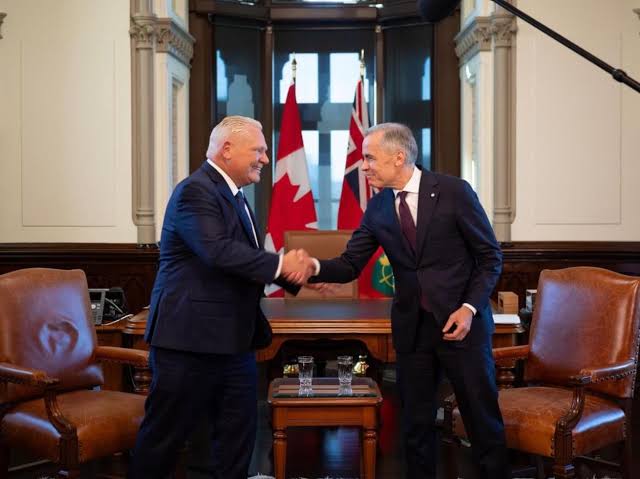
Prime Minister Mark Carney and Ontario Premier Doug Ford have unveiled a joint package of Ontario tariff funding worth $8.7 billion, aimed at shoring up the province’s steel mills, retooling its auto sector and opening up the mineral-rich Ring of Fire in Northern Ontario. The two leaders made the announcement at a joint news conference in Ottawa on Wednesday, October 21, 2026, as Canada’s trade conflict with the United States under President Donald Trump stretches past the year-and-a-half mark.
Initial reports described the package as coming entirely from the federal government, but a later correction clarified that it is jointly funded, with Ontario contributing $2.67 billion. Details of the plan were outlined in BNN Bloomberg’s coverage of the announcement, which also noted that the measures are designed to protect existing jobs while building new domestic supply chains.
Breaking Down the Ontario Tariff Funding
The largest piece of the package is $5 billion earmarked for upgrading Ontario steel mills. Steel producers have been among the hardest-hit Canadian industries since Washington began imposing tariffs, and modernization funding is intended to keep plants competitive while they adjust to a reshaped North American market.
A further $2.5 billion will support the auto industry as it shifts toward electric vehicle production. Ontario is the heart of Canada’s auto manufacturing base, and the sector has faced both tariff pressure and the cost of a technology transition at the same time. Another $1 billion is dedicated to building roads into the Ring of Fire, a remote region in Northern Ontario that has long been viewed as one of the country’s most promising sources of critical minerals but has lacked the infrastructure needed for development.
According to Carney, the Ring of Fire investment is linked to roughly 70,000 jobs, while the broader package is expected to help protect about 220,000 jobs in other industries. Those projections come from the government, and how many positions are actually created or preserved will depend on private-sector decisions, project timelines and the path of U.S. trade policy.
New Tools to Protect Canadian Steel
Alongside the spending, both governments launched the Joint Steel Action Fund, which is meant to support the production of steel used in products Canada needs. The idea is to direct more domestic demand toward domestic producers rather than relying on imports.
The governments also pledged stronger enforcement by the Canada Border Services Agency against foreign steel dumping, the practice of selling steel into a market at artificially low prices. Canada imports more than 6.5 million tonnes of steel every year, and domestic producers have long argued that cheap imports undercut them, a concern that grows sharper when U.S. tariffs redirect global steel flows toward other markets.
Relief for Automakers on Emissions Rules
For the auto sector, the announcement included a regulatory change as well as money. The fleet average performance standard for new light-duty vehicles will be frozen at 172 grams per mile through 2029, with annual tightening resuming in the 2030 model year. In practical terms, this gives automakers additional breathing room on emissions compliance during a period when their margins are already under strain from tariffs and the costly pivot to electric vehicles.
Carney framed the overall approach as a turning point, saying U.S. tariffs “have upended a trade bargain that’s existed for decades” and that it is “time to be our own best customer.” He added that simply protecting existing industries is not enough and that Canada must go further. Ford called the package a “historic agreement” and said Canada’s relationship with the United States “has changed permanently.”
What It Means for Canadian Investors
For investors, the Ontario tariff funding sends a clear signal that governments are prepared to put significant capital behind domestic heavy industry. Canadian steel producers and suppliers to the auto sector could benefit from modernization dollars, stronger anti-dumping enforcement and a policy push to buy Canadian. That said, public funding does not erase tariff costs, and companies that depend heavily on exports to the United States still face an uncertain demand outlook.
The Ring of Fire commitment is likely to draw attention from the mining and infrastructure sectors. Road access has been a key barrier to developing the region, so funding for that work could improve the long-term economics of projects there. However, mining developments typically take many years to move from planning to production, and investors should treat this as a long-horizon theme rather than a near-term catalyst.
There is also a fiscal dimension. The announcement came just a day after Ottawa trimmed its economic forecast for 2026 and 2027 in the face of new U.S. tariffs. Large spending commitments at a time of slower growth can add to government borrowing needs, which in turn can influence bond yields. Investors in Canadian government debt will want to watch how this and similar programs are financed.
The Bigger Picture for Households
For Ontario households, the most direct impact is likely to be on employment. The steel and auto sectors support large numbers of well-paid manufacturing jobs, along with many more positions in supplier networks and local service economies. Measures that help keep plants running can ease pressure on communities that rely on them.
The emissions freeze may also affect consumers indirectly by easing some cost pressure on automakers, though how that plays out in vehicle prices will depend on many other factors, including tariffs and supply chain costs. Over the longer term, the emphasis on electric vehicle production suggests governments still see the EV transition as central to the future of Ontario’s auto industry.
Conclusion
The $8.7 billion Ontario tariff funding package reflects a broader shift in Canadian economic policy, from waiting for a return to normal trade relations toward actively rebuilding domestic capacity. As Ford put it, Canada is “not going back to the way things were.” For investors, the measures offer potential support for steel, autos and critical minerals, but the benefits will take time to materialize and will depend heavily on how the trade relationship with the United States evolves from here.