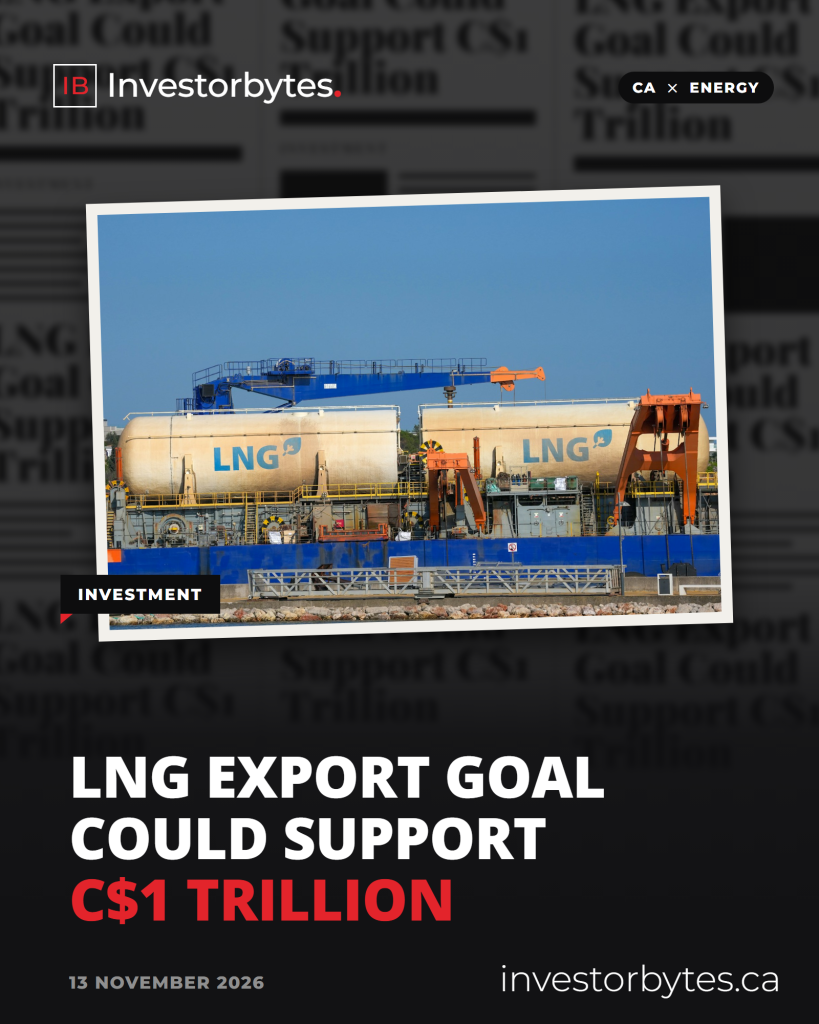
Canada LNG exports of 100 MMtpa could support C$1 trillion of investment and 250,000 jobs a year through 2050, a new S&P Global Energy study finds.
Canada LNG exports could support nearly C$1 trillion of investment and about 250,000 jobs a year through 2050 if the country reaches the federal ambition of 100 million tonnes per annum (MMtpa), according to a new study from S&P Global Energy. The study was released on November 12, 2026, and was first reported in Canada by EnergyNow.
The report is titled Nation Building through LNG and NGLs: Powering Canada’s Economic Growth, Trade and Global Energy Security. It looks at what the country could gain from liquefied natural gas (LNG) and natural gas liquids (NGLs), and what stands in the way.
Table of Contents
What the Canada LNG Exports Study Found
The headline finding is simple. If Canada LNG exports reach 100 MMtpa by 2050, the economic payoff would be very large. S&P Global Energy says this level of Canada LNG exports would stimulate nearly C$1 trillion in total investment across the LNG value chain.
The study also says the build-out would support nearly 250,000 jobs every year and add C$888 billion to gross domestic product (GDP) through 2050. That GDP figure works out to about C$50,000 per household, according to the release.
Growing Canada LNG exports to that level would also make Canada the world’s third-largest LNG exporter, the study says.
Key numbers at a glance
| Measure (through 2050) | Study estimate |
|---|---|
| Total investment across the LNG value chain | Nearly C$1 trillion |
| Jobs supported each year | Nearly 250,000 |
| Contribution to GDP | C$888 billion |
| GDP per household | About C$50,000 |
| Total Canadian business revenues | C$1.6 trillion |
| Tax revenues | C$151 billion |
| Current trajectory for LNG exports | 36 MMtpa by 2050 |
The study adds that about 20% of the jobs and GDP gains would happen outside the Western Canadian producing provinces.
What Is LNG and Why Does It Matter?
Liquefied natural gas is natural gas that has been cooled to a very low temperature so it turns into a liquid. In liquid form it takes up far less space, so it can be loaded onto special tankers and shipped across oceans.
For a gas-rich country, Canada LNG exports open markets beyond North America. Without export terminals, most Canadian gas is sold by pipeline, mainly to the United States. LNG lets producers reach buyers in Asia and Europe, often at different prices. That is why Canada LNG exports are seen as a way to diversify trade.
Gas Supply Behind Canada LNG Exports
The study says Canada has 375 trillion cubic feet (Tcf) of gas identified so far that is economic at below US$3 per million British thermal units (MMBtu). At that price, it says, the resource base is more than enough for over 50 years of domestic demand plus LNG exports.
On a proportional basis, the study says this is larger than the resource position of the United States and Australia, two of the biggest LNG suppliers today.
The Montney basin, which straddles northeast British Columbia and northwest Alberta, is a key part of the story. According to S&P Global Energy, the Montney alone could largely supply the extra 9 billion cubic feet per day (bcf/d) of feedgas needed to reach 100 MMtpa.
Canada also has a dual-coast position. The study says this offers secure shipping routes to major demand centres that are free of geopolitical chokepoints.
Emissions Profile of Canadian LNG
The study argues that Canada LNG exports have a lower carbon footprint than many rivals. It says Canadian projects have 55% lower greenhouse gas intensity than similar projects in other countries that have not yet reached a final investment decision. Part of this comes from electric-driven compression powered by a clean grid.
S&P Global Energy says accelerated development would mainly displace higher-emission projects, as well as coal and oil used for power and industry in Asia. It estimates this could avoid 44 million tonnes of CO2-equivalent per year. That equals the energy use of about 10 million gasoline-powered cars, or 13 million Canadian homes, every year.
The Role of Natural Gas Liquids
The report also looks at NGLs, which travel alongside Canada LNG exports in the gas value chain. They include ethane, propane, butane and condensate. These make up about 24% of a typical gas well’s output but can account for up to half of its economic value.
- Ethane, propane and butane are used for home heating, chemicals and exports.
- Condensate is the main diluent used to move oil sands bitumen through pipelines.
- Under the study’s Accelerated Development Case, extra domestic condensate could support 1.2 million barrels per day of oil sands supply at its 2040 peak.
- NGL production would nearly triple through 2050, adding C$300 billion in incremental value.
Challenges to Reaching the Canada LNG Exports Goal
The study is clear that the 100 MMtpa ambition for Canada LNG exports will not happen on its own. On the current path, Canada LNG exports are on track for about 36 MMtpa by 2050. Closing that gap would require a 2.5 times increase in upstream and critical infrastructure investment, and a tripling of upstream drilling activity.
A crowded global market
Competition for Canada LNG exports is intense. The study says more than 600 million tonnes of projects worldwide are competing for 176 million tonnes of market opportunity by 2050. Global LNG supply is expected to grow 50% over the next five years after a two-year investment wave. S&P Global Energy expects the market opportunity to shrink sharply after 2027 until the early 2030s, which adds urgency.
Permitting, costs and policy stability
- Pipeline permitting in Canada takes 27 months longer than in Texas, according to the study.
- Pipelines cost 160% more to build in Canada, and permitting alone accounts for over 50% of pipeline project development.
- Over two decades, Canada saw nine significant fiscal policy changes to royalty and income tax terms for upstream projects. The study compares this with two in the United States, one in Australia and four in Argentina.
- Electrifying all LNG facilities could need 3.1 gigawatts of extra power capacity by 2050, double the recent pace of net additions in British Columbia.
Daniel Yergin, Vice Chairman of S&P Global, said the country “will need to move at speed to improve its position.” Kevin Birn, Chief Canadian Energy Analyst at S&P Global Energy, said long-term investment certainty and further cost and timeline reductions are critical.
What It Means for Investors and Households
The study identifies four enablers: streamlined permitting, more stable policies that affect project economics, value-chain integration or government partnerships to share risk, and Indigenous partnerships to speed up development. It does not make policy recommendations.
For investors, the report frames Canada LNG exports as a long-term growth theme that touches gas producers, pipeline operators, power utilities and service companies. Progress on permits and final investment decisions will be the signals to watch. Energy demand also affects the loonie, which is covered in our report on the Canadian dollar near a 19-month low.
For households, the study’s estimate of about C$50,000 in GDP per household and C$151 billion in tax revenue shows the scale of what is at stake. Resource-led growth is also a theme elsewhere, as seen in Pakistan’s plans for a major mining export project. Canadian capital markets are changing too, with the TSX proposing longer trading hours on Alpha.
The study was produced by S&P Global CERA Consulting and S&P Global Market Intelligence, with support from the Calgary Chamber of Commerce. Read the full S&P Global Energy press release, or visit S&P Global for more research.
Frequently Asked Questions
What is Canada’s LNG export goal?
The federal ambition is 100 million tonnes per annum (MMtpa) of LNG exports. The S&P Global Energy study models reaching it by 2050.
How much investment could Canada LNG exports bring?
The study estimates nearly C$1 trillion in total investment across the LNG value chain, plus about 250,000 jobs a year and C$888 billion added to GDP through 2050.
Where are Canada LNG exports heading now?
On its current path, Canada is on track for about 36 MMtpa by 2050, well short of the 100 MMtpa goal.
What are the main barriers?
The study points to slow and costly pipeline permitting, frequent fiscal policy changes, the need for more power to electrify LNG plants, and strong global competition.
This article is for information only and is not financial advice.