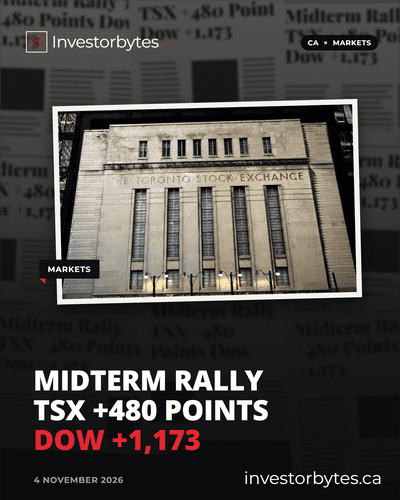
The TSX midterm rally added 480 points early Wednesday as the Dow rose 1,173. What the post-election surge means for Canadian investors and the loonie.
A TSX midterm rally greeted Canadian investors on Wednesday, Nov. 4, after U.S. voters handed Democrats control of both houses of Congress. In early trading, the S&P/TSX composite index rose 480.11 points to 36,012.39, according to The Canadian Press. South of the border, the Dow Jones industrial average jumped 1,173.36 points to 52,960.08. The move came after a choppy stretch for markets that included a tech-led sell-off in late October, and it gave Canadian portfolios a sharp lift as the election results settled in.
Table of Contents
How the TSX midterm rally unfolded
The gains arrived quickly after the opening bell. Beyond the Dow, the S&P 500 added 102.23 points to 7,671.15 and the Nasdaq composite climbed 310.72 points to 25,682.73 in early trading, The Canadian Press reported. The early numbers were snapshots rather than closing figures, and the session kept moving. Later in the day, the headline on the same wire story was updated to say the Toronto index was up more than 600 points, a sign that buying continued after the first hour.
The size of the Dow’s move stood out. A gain of more than 1,100 points is large in absolute terms, though the index’s high starting level means the percentage change was closer to the gains seen in other benchmarks. The Toronto market’s advance was broadly in line, a reminder of how closely Canadian equities track sentiment on Wall Street when U.S. politics is the main driver.
U.S. stock futures had already signalled a strong open. Before markets opened, Dow futures were up 1.4 per cent and S&P 500 futures were up 1 per cent, according to an Associated Press report carried by BNN Bloomberg. European benchmarks in London, Paris and Frankfurt were also higher in early trading.
Commodities and the Canadian dollar
Commodity moves gave a mixed picture for Canada’s resource-heavy market. December crude oil fell US$3.11 to US$92.98 per barrel, while December gold rose US$107.40 to US$4,047.80 an ounce, per The Canadian Press. Lower oil prices can weigh on energy producers, which make up a large share of the TSX, but a sharp gain in gold supports the many Canadian miners listed in Toronto.
The loonie edged up as well, trading at 71.68 U.S. cents compared with 71.46 cents on Tuesday. A firmer Canadian dollar slightly reduces the value of U.S. holdings for Canadian investors when converted back to loonies, though the move was small. Details on each index and commodity are in the Canadian Press markets report.
Why markets cheered the election result
Market strategists offered a cautious read on the rally. Stephen Brown of Capital Economics said the Democratic gains do not change much for the near-term policy outlook, because the party lacks a filibuster-proof Senate majority and the president keeps his veto, according to the Associated Press report. Carsten Brzeski, global chief of macro at ING, laid out two paths: a frustrated president who revives disputes over tariffs and NATO spending, or a more restrained one who slows disruptive policy moves.
The AP report also noted that wind energy stocks rose and defence stocks mostly fell before the open, as investors weighed what a divided government might mean for different industries. Some Asian markets had slipped earlier on concerns that Democrats could slow the build-out of artificial intelligence infrastructure. For Canada, where trade with the U.S. matters more than for most economies, investors appear to be betting that a Congress with more scrutiny of tariffs could reduce some trade risk over time. That is an expectation, not a policy change, and tariffs remain in place.
What the TSX midterm rally means for Canadian investors
Big one-day moves tied to a political event can fade as quickly as they arrive. The early gain of 480 points works out to roughly 1.4 per cent for the TSX, a strong day but not unusual during periods of high uncertainty. Investors who sold during the October tech slump may feel pressure to buy back in after a jump like this. A more measured approach is to rebalance toward target allocations instead of chasing the rally.
Several groups of Canadian stocks are worth watching. Exporters, manufacturers and forestry companies are the most sensitive to any progress in Canada-U.S. trade talks. Gold miners benefit when bullion rises, as it did on Wednesday. Energy producers could face pressure if crude continues to slide. Banks tend to track overall economic confidence and interest-rate expectations.
It is also worth separating the TSX midterm rally from the fundamentals that drive returns over longer periods. Corporate earnings, interest rates set by the Bank of Canada and the U.S. Federal Reserve, commodity prices and the outcome of trade negotiations will matter far more over the next year than the first trading day after an election. A rally built on expectations can reverse if those expectations are not met, so investors should look for follow-through in the weeks ahead.
For holders of U.S. index funds in RRSPs or TFSAs, the Dow and S&P 500 gains will show up directly, minus any small currency effect from the stronger loonie. Those with currency-hedged funds will see returns closer to the U.S. index moves.
What households should take from the surge
For most Canadian households, a single strong session does not change a long-term plan. Retirement savers with regular contributions are already buying through both rallies and slumps, which smooths out the effect of political events. The bigger household stories remain borrowing costs, the housing market and the price of everyday goods, including heating fuel, which the drop in crude could help ease if it persists.
Anyone tempted to time the market around trade news should keep in mind that the U.S. president still controls tariff policy, and that Ottawa and Washington have not yet announced a deal. Headlines can move in either direction.
A practical step for households is to review emergency savings and debt levels before adjusting investments. Market gains are welcome, but they do little for a household budget that is stretched by rising costs. Paying down high-interest debt remains one of the most reliable returns available to Canadians, regardless of what the stock market does on any given day.
Conclusion
The TSX midterm rally showed how sensitive Canadian markets are to U.S. political shifts, with the index up 480 points and the Dow up 1,173 points early on Nov. 4. Gains in gold, a firmer loonie and softer oil shaped the day for Canadian sectors. Investors should welcome the bounce but stick to their allocation plans, since the policy impact of the election will take months to become clear.
https://ca.investorbytes.com/ultra-maritime-acquisition/