
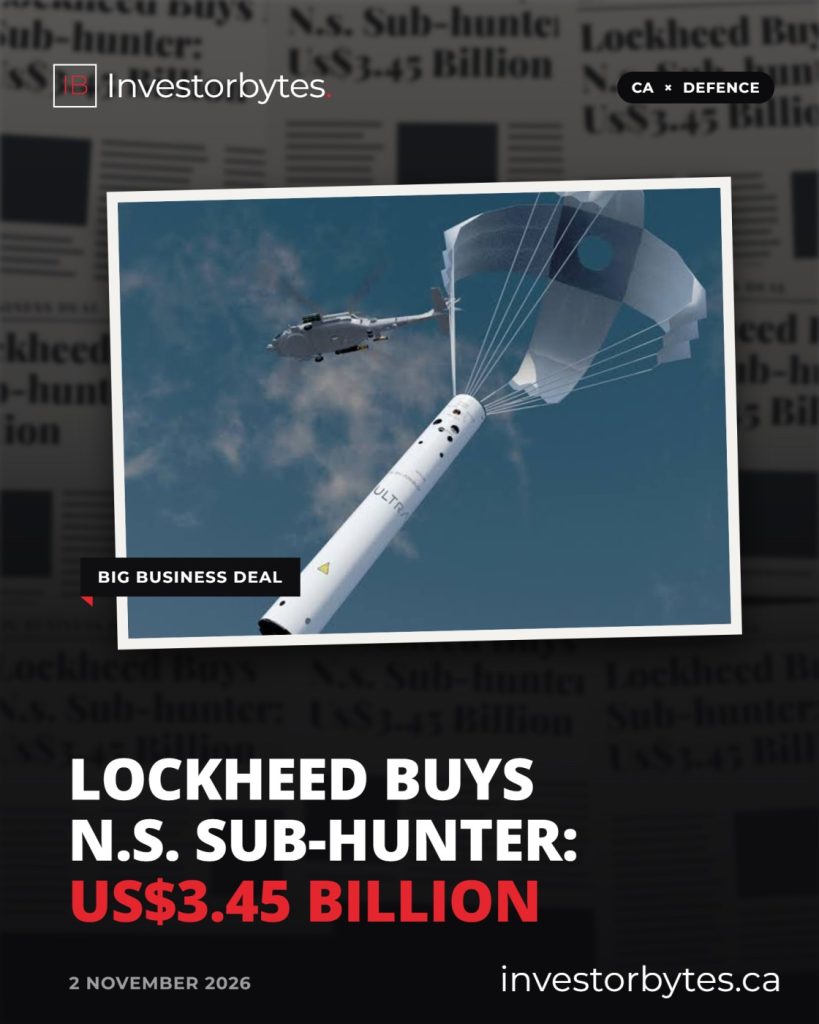
Lockheed Martin’s US$3.45B Ultra Maritime acquisition puts a Dartmouth sonar maker in U.S. hands. What the deal means for Canadian investors.
One of Atlantic Canada’s most specialized defence manufacturers now belongs to the largest weapons maker in the United States. Lockheed Martin has completed the Ultra Maritime acquisition, paying US$3.45 billion for the Dartmouth, Nova Scotia, company that builds the sensors navies use to find and track submarines. The agreement was signed in July and closed in the final week of October, giving the U.S. contractor full control of a business it had already held an investment in since 2022.
For Canadian investors, the transaction is a reminder of two things at once: global demand for undersea warfare equipment is climbing fast, and many of the Canadian firms best placed to benefit are either privately held or end up owned by foreign buyers. Below, we look at what Ultra Maritime does, why Lockheed wanted it, and where the opportunities and risks sit for anyone with money in the Canadian market.
Table of Contents
What Ultra Maritime Builds in Dartmouth
Ultra Maritime traces its roots back to 1947, when it started life as Cossar (Canada) Ltd. Over almost eight decades it has grown into a niche leader in anti-submarine warfare. Its product line includes sonar systems, sonobuoys, which are expendable listening devices dropped from aircraft into the ocean, and torpedo defence technology. According to the company, its equipment helps the navies of more than 30 countries, Canada and the United States among them, detect and follow hostile submarines.
The business employs roughly 2,000 people across five countries. Ottawa said last year that more than 250 of those jobs are in Dartmouth, which keeps a meaningful share of the firm’s engineering and production footprint in Nova Scotia. That local base matters, because the Halifax region is home to Canada’s largest naval base and an expanding cluster of shipbuilding and defence suppliers.
Why Lockheed Martin Wanted Full Control
Lockheed has framed the purchase as a way to keep up with rising demand for undersea capability among the U.S. and its allies. Stephanie Hill, who leads the company’s Rotary and Mission Systems division, said the deal speeds up Lockheed’s push to supply advanced undersea and anti-submarine systems to American and partner forces. Details of the closing are laid out in The Canadian Press report on the closing, which was published on November 1.
The strategic logic is easy to follow. Submarine fleets are growing in several regions, and the ability to detect them has become a priority for alliance planners. Sonobuoys in particular are consumable items: once deployed they are not recovered, which creates recurring orders rather than one-off sales. Owning the supplier outright lets Lockheed fold that steady demand into its broader mission-systems business instead of sharing the economics with other owners.
Why the Ultra Maritime Acquisition Matters for Nova Scotia
The closing caps a busy year for defence investment in the province. In July, Lockheed Martin Canada signed a partnership with Invest Nova Scotia and pledged to create up to 320 skilled positions in the province over five years, along with as much as $126 million in salaries and benefits. Those commitments were tied to demand for the company’s Canadian-built combat management system.
That same month, Prime Minister Mark Carney named German shipbuilder TKMS as the preferred bidder to build 12 new submarines for the Royal Canadian Navy. A program of that size is expected to bring more sailors, maintenance crews and naval suppliers to Halifax. Taken together, these developments suggest the Halifax-Dartmouth corridor is becoming a genuine hub for naval technology, with both Canadian and foreign capital flowing in.
There is a policy question underneath the excitement. Defence technology is the kind of sector where foreign takeovers can attract scrutiny under the Investment Canada Act, which allows Ottawa to review deals on national security grounds. Public reports on this transaction did not describe any review process, so investors should not assume one way or the other. What is clear is that a long-standing Canadian anti-submarine supplier now reports to a U.S. parent.
What Canadian Investors Can Take From the Deal
The most direct takeaway is that the price tag itself is a valuation signal. A buyer willing to pay billions for a specialist sonar maker is telling the market that undersea warfare is a growth niche, not a sleepy corner of the defence budget. That reads through to other suppliers that serve navies, including shipbuilders, electronics makers and maintenance providers.
The harder truth is that Canadians who want exposure to this theme have limited options at home. Ultra Maritime was not listed on the TSX, so domestic shareholders never had a chance to own it directly. Exposure to the deal now comes mainly through Lockheed Martin shares on the New York Stock Exchange, or through U.S. and global defence funds that hold the company. Buying U.S. stocks brings currency risk for Canadian-dollar investors, and dividends from U.S. companies are subject to withholding tax outside of an RRSP.
Investors who prefer to stay closer to home can look at the broader Canadian defence and aerospace supply chain, but should do so with care. Many smaller suppliers depend heavily on a few government contracts, and their revenue can swing with procurement timelines. Diversification through a sector fund, rather than a concentrated bet on one contractor, may suit most portfolios better.
Risks Worth Watching After the Ultra Maritime Acquisition
Defence spending has strong momentum, with NATO members having agreed in 2025 to a much higher long-term spending goal and Ottawa pledging to rebuild the navy. Even so, budgets are political. Shifts in government priorities, delays in major programs such as the submarine replacement, or trade friction between Canada and the United States could all affect how quickly orders turn into revenue.
Integration is another variable. Large acquirers sometimes consolidate operations or move work closer to head office. Lockheed’s job commitments in Nova Scotia point in the opposite direction, but local employment levels are worth monitoring over the next several years as a test of how the deal plays out on the ground.
Finally, there is valuation risk in the sector as a whole. Defence stocks have attracted heavy inflows as geopolitical tension has risen. When a theme becomes crowded, prices can run ahead of earnings, and corrections can be sharp if spending expectations cool.
Conclusion
The Ultra Maritime acquisition shows how valuable Canadian anti-submarine know-how has become, and how readily that value can be captured by foreign buyers. For Nova Scotia, the deal arrives alongside new job pledges and a major submarine program that should keep the region busy for years. For investors, it underlines strong demand for undersea defence technology while also highlighting how few pure-play ways there are to own that growth on Canadian exchanges. A measured, diversified approach remains the sensible way to take part.
https://ca.investorbytes.com/caregivers-in-canada/