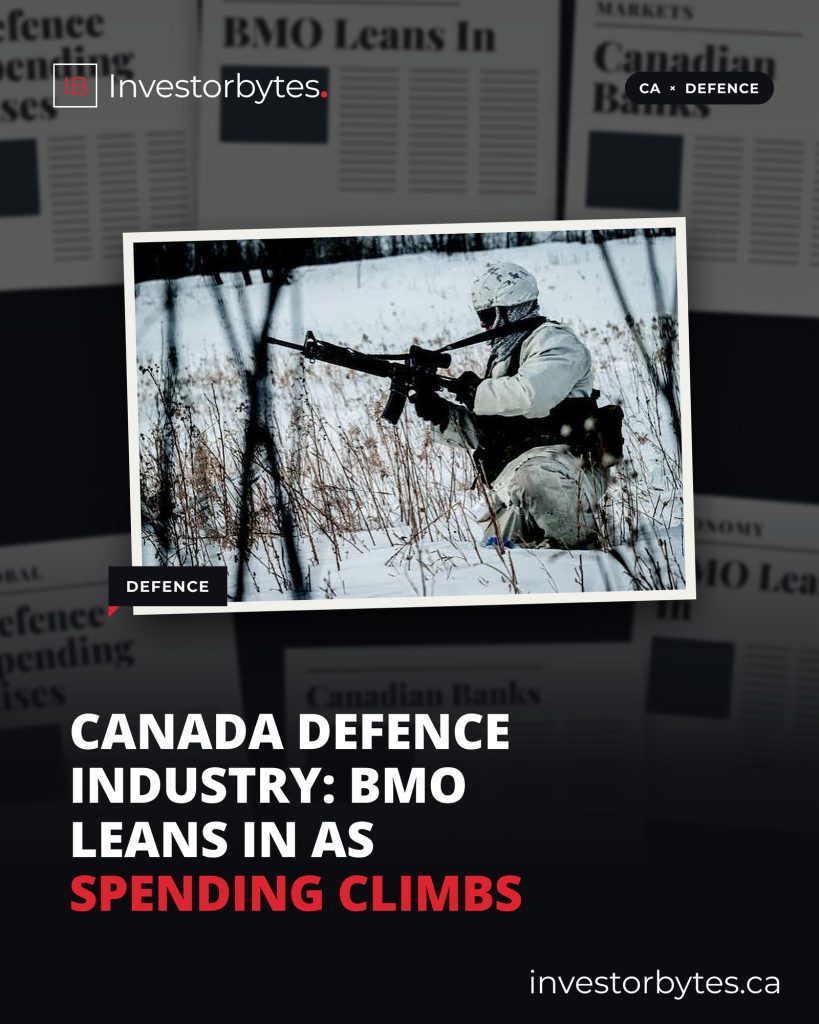
Bank of Montreal is stepping up its commitment to the Canada defence industry, betting that a federal push to raise military spending will create one of the largest new lending and advisory opportunities the country has seen in years. Chief executive Darryl White said the bank is responding to clear signals from Ottawa and is now “leaning into it even more heavily than we were before,” according to a Canadian Press report carried by BNN Bloomberg published on October 21, 2026.
Why BMO Is Doubling Down on Defence
White pointed out that BMO is not new to the sector. The lender has long served defence companies of all sizes, from small domestic suppliers to large established firms. What has changed is the policy backdrop. The federal government has tied higher defence outlays to its broader Build Canada agenda, which aims to accelerate investment in infrastructure, energy and strategic industries.
That shift is reflected in the bank’s own forecasts. An October report from BMO economists estimated that Canada’s pledge to spend five per cent of annual gross domestic product on defence by 2035 could generate roughly $150 billion in annual economic impact by that year. White described the chance of reaching the target as high, citing procurement and infrastructure commitments he expects governments to honour.
“We haven’t seen something that can singularly deliver that much economic impact in this country in a very long time,” White said.
BMO’s Recent Moves in the Canada Defence Industry
The bank has been building toward this moment for most of 2026. In February, BMO joined the Defence, Security and Resilience Bank, a NATO-backed initiative designed to lower borrowing costs for military spending by pooling the credit strength of participating members. In September, it pledged to mobilize up to $70 billion in new capital over 10 years across priority sectors, including defence, electricity infrastructure, energy, transportation, oil and gas, mining and artificial intelligence.
BMO has also created a dedicated leadership role. Michael Bonner was named enterprise chair of the bank’s Canadian defence sector segment, with a mandate that includes working with government agencies and industry associations on defence financing, export credit and procurement. In a news release, Bonner said BMO has the experience and relationships to help clients of every size benefit from growth in the sector.
The bank’s profile in the sector will be on display this week. BMO is co-hosting a defence forum in Toronto on Thursday with the Institute of International Finance, bringing together finance leaders from across the country’s defence supply chain to discuss opportunities and obstacles. White is also scheduled to speak at the Toronto Global Forum on Wednesday, an event whose main themes include AI, energy, infrastructure, finance and defence.
Competition Heats Up Among Canada’s Big Banks
BMO is not alone in chasing defence-related business. CIBC has committed $2 billion to small and medium-sized defence companies whose products also have civilian, or dual-use, applications. TD has pledged $150 billion over five years to key industries that include defence. All six of Canada’s largest banks have expressed support for the Defence, Security and Resilience Bank.
For investors in Canadian bank stocks, this growing focus matters for several reasons. Defence contracts are often long-term and backed by government spending, which can make them attractive lending and advisory relationships. Large procurement programs also tend to generate demand for project finance, working capital facilities, trade finance and capital markets work as suppliers expand. If spending ramps up as planned, banks that establish strong client relationships early could gain a lasting edge.
There are also risks. Procurement timelines in Canada have historically been slow, and defence budgets can change with political priorities. A bank that commits heavily to a sector whose spending arrives later than expected may see returns on that effort take longer to materialise.
What Higher Defence Spending Means for Canadians
The five per cent target reflects a commitment made by NATO allies in 2025, which combines core military spending with broader security and resilience investments. For Canada, which for years spent well below the alliance’s previous two per cent benchmark, reaching that level would represent a major reallocation of public resources.
The economic implications for households are mixed. On one hand, a sustained increase in defence procurement could support jobs in manufacturing, shipbuilding, aerospace, technology and construction, along with the regions that host those industries. On the other hand, higher military budgets must be financed through some combination of tax revenue, borrowing and spending trade-offs elsewhere, which will be a key debate as Ottawa prepares future budgets.
For the Canada defence industry itself, greater access to private capital could be as important as government contracts. Many smaller suppliers have struggled to finance expansion, and bank commitments aimed at that segment could help them scale up to meet demand.
Investor Sentiment and the Road Ahead
White also addressed the wider investment climate. In September, Toronto hosted Canada’s first national investment summit, drawing hundreds of executives and global asset managers. Prime Minister Mark Carney used the event to set a goal of attracting $1 trillion in new investment over five years.
White said foreign investors’ views of Canada have shifted and that the summit helped bring them closer to opportunities in the country. However, he cautioned that such gatherings are not where transactions are finalised. Deals happen when conditions are right, he said, adding, “I don’t think we’re there yet, but we’ve certainly done a good job laying more groundwork.”
That measured tone is worth noting. Bank executives are signalling enthusiasm about defence and nation-building projects, but they are also acknowledging that execution, regulatory clarity and project readiness will determine how quickly capital actually flows.
Conclusion
BMO’s renewed push into defence shows how Canada’s largest lenders are positioning for a new era of military and infrastructure spending. If Ottawa delivers on its procurement plans, the Canada defence industry could become a meaningful source of growth for banks, suppliers and the broader economy. For investors, the key will be tracking whether those commitments translate into signed contracts and steady deal flow in the years ahead.