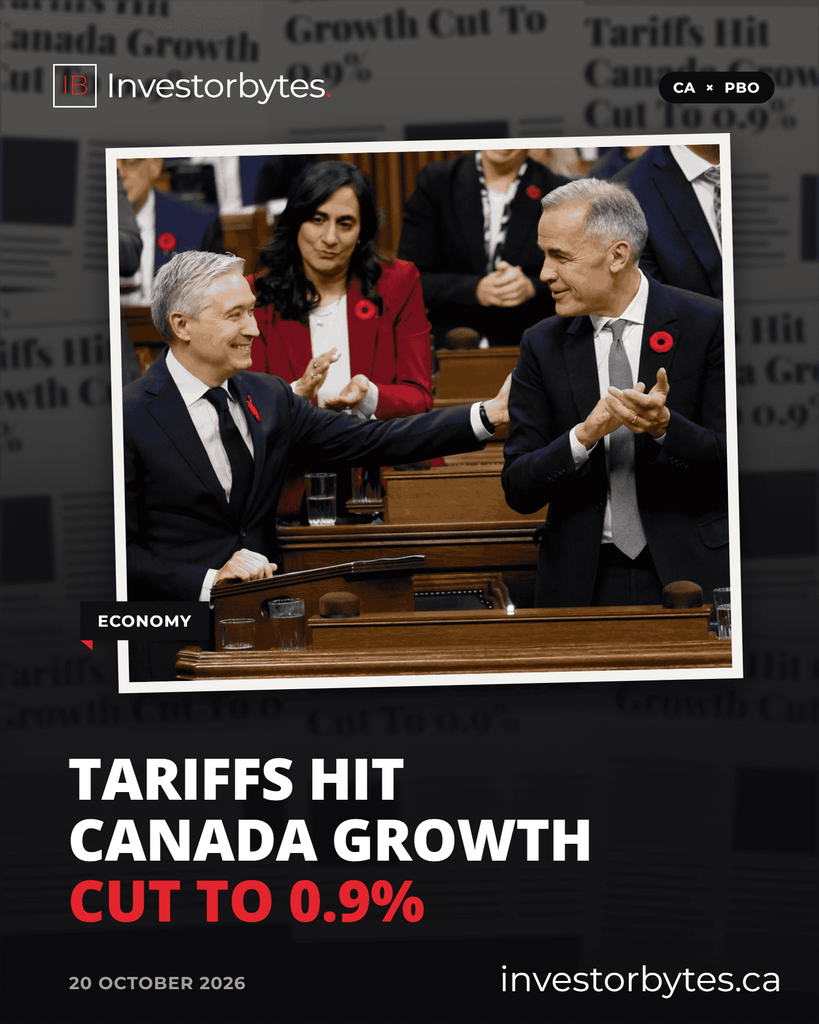
Canada economic growth forecast falls to 0.9% for 2026 as US tariffs weigh on growth. The PBO projects a $63.3 billion deficit in 2026–27.
Canada Economic Growth Forecast Slashed to 0.9% in 2026
Canada’s economic outlook has weakened after the Parliamentary Budget Officer (PBO) lowered its growth projections for 2026 and 2027, highlighting the growing economic pressure associated with new United States tariffs and ongoing trade uncertainty. The latest Canada economic growth forecast points to slower economic momentum, while the federal deficit is expected to reach billions of dollars over the next two fiscal years.
In its October 20, 2026, Economic and Fiscal Outlook, the PBO projected Canada’s real gross domestic product (GDP) to grow by just 0.9% in 2026 and 1.5% in 2027. These estimates are lower than the previous June projections of 1.1% and 1.6%, respectively.
The report also projects a federal budget deficit of $63.3 billion in the 2026–27 fiscal year, rising to a peak of $70.2 billion in 2027–28. These figures have put Canada’s economic performance, trade policy and public finances under renewed scrutiny.
Table of Contents
- Canada’s Revised Economic Growth Forecast
- How US Tariffs Are Affecting Canada’s Economy
- Canada’s Federal Deficit Could Reach $70.2 Billion
- What Slower GDP Growth Means for Canadians
- Business Investment and Trade Diversification
- What to Watch in Canada’s Economic Outlook
- Frequently Asked Questions
1. Canada’s Revised Economic Growth Forecast
The latest Canada economic growth forecast reflects a more challenging environment for businesses, exporters and policymakers. According to the PBO, real GDP growth is expected to remain modest as the country adjusts to changing trade conditions.
The revised projections show the following changes:
| Economic indicator | June forecast | October forecast |
|---|---|---|
| Real GDP growth in 2026 | 1.1% | 0.9% |
| Real GDP growth in 2027 | 1.6% | 1.5% |
| Federal deficit, 2026–27 | Previous outlook | $63.3 billion |
| Projected deficit peak, 2027–28 | Previous outlook | $70.2 billion |
Although the reductions in projected GDP growth may appear relatively small, they matter because economic growth influences employment opportunities, household income, corporate revenue and government tax collections.
A slower-growing economy can make it more difficult for businesses to expand, increase wages or commit to major investment projects. However, weaker GDP growth does not automatically mean Canada is entering a recession. These figures represent projections, and actual economic performance may differ as trade conditions and domestic demand evolve.
The distinction between real and nominal GDP is also important. Real GDP measures changes in economic output after accounting for inflation, while nominal GDP reflects both output and price changes.
2. How US Tariffs Are Affecting Canada’s Economy
Trade relations with the United States remain a significant factor in Canada’s economic outlook. The two countries maintain deeply connected supply chains across manufacturing, energy, automotive production, agriculture and other industries.
New US tariffs and Canadian countermeasures have added uncertainty for companies that depend on cross-border trade. Businesses facing higher costs or changing market access may delay expansion, reconsider suppliers or adjust their pricing strategies.
The PBO’s October outlook incorporates tariff measures and Canadian countermeasures in place as of October 1, 2026. It estimates that the combined bilateral trade measures introduced since early 2025, if they remain permanent, could reduce the level of real GDP by approximately 1.4% over the medium term compared with a scenario without those measures.
This is an estimate of the potential difference in the level of economic output, not a prediction that Canada’s GDP will fall by 1.4% in a single year.
For Canadian exporters, the implications include uncertainty around future orders, production costs and competitiveness. Import-dependent businesses may also face higher input costs, potentially affecting prices for consumers.
The revised Canada economic growth forecast therefore highlights the importance of trade negotiations, predictable commercial rules and efforts to strengthen access to international markets.
3. Canada’s Federal Deficit Could Reach $70.2 Billion
Alongside weaker growth, the PBO expects the federal budget deficit to remain substantial.
The deficit is projected to reach $63.3 billion in 2026–27, equivalent to approximately 1.8% of GDP. It is then expected to peak at $70.2 billion in 2027–28, or around 2.0% of GDP.
The PBO estimates that deficits will average approximately $3 billion more per year than its June outlook over the 2026–27 to 2030–31 period. New government measures are expected to more than offset improvements from stronger revenues and other economic and fiscal developments.
A federal deficit occurs when government spending exceeds its revenues over a fiscal year. The government finances that gap through borrowing, adding to its financing requirements.
Persistent deficits can increase interest costs and reduce the government’s flexibility to respond to future economic shocks. At the same time, deficit figures must be assessed alongside the purpose of government spending, economic conditions and the long-term effects of public investment.
The PBO’s projections provide parliamentarians and the public with a baseline assessment of the fiscal outlook under current policy settings. They are not a guarantee of the final budget outcome.
4. What Slower GDP Growth Means for Canadians
The Canada economic growth forecast is important because changes in national output can influence everyday financial decisions.
When economic growth slows, employers may become more cautious about hiring, while some businesses could postpone expansion plans. Workers in industries exposed to international trade may face greater uncertainty if companies experience lower demand or higher production costs.
Households may also feel the effects through changes in job availability, wage growth, consumer prices and borrowing conditions. However, the impact will vary by region, industry and household circumstances.
Manufacturers that rely heavily on cross-border supply chains may experience different pressures from service businesses that primarily serve domestic customers. Energy producers may also respond differently to changes in commodity prices than companies in retail or transportation.
It is important to distinguish economic forecasts from confirmed outcomes. The PBO’s projections do not establish that every Canadian household will experience falling income or that every industry will contract.
Instead, the figures indicate that Canada’s economic expansion could remain more subdued than previously anticipated.
5. Business Investment and Trade Diversification
A key challenge for Canadian policymakers is helping businesses adapt to a changing international trade environment.
Companies may explore alternative export destinations, invest in productivity improvements or reconsider their supply chains to reduce exposure to unpredictable trade barriers. Expanding trade relationships beyond a single major market could provide additional opportunities, although diversification often requires time, capital and new commercial partnerships.
Domestic investment in infrastructure, technology, energy and advanced manufacturing may also support productivity and long-term economic capacity.
Nevertheless, investment decisions depend on several factors, including expected demand, financing costs, regulatory conditions, labour availability and confidence in future market access.
For businesses, the revised Canada economic growth forecast is a reason to review risk exposure and financial assumptions rather than assume that economic conditions will remain unchanged.
For policymakers, the challenge is to support economic resilience while maintaining sustainable public finances and responding to the immediate pressures created by international trade disputes.
6. What to Watch in Canada’s Economic Outlook
Several developments could influence Canada’s economic performance over the coming months.
US–Canada trade relations: Changes to tariffs, countermeasures or trade negotiations could affect exporters, importers and manufacturing supply chains.
Federal budget decisions: New spending or revenue measures could alter future deficit projections and the government’s financing requirements.
GDP and employment data: Statistics Canada releases will help show whether economic activity and labour-market conditions are improving or weakening relative to expectations.
Business investment: Corporate spending on equipment, facilities and technology will be an important indicator of confidence in Canada’s medium-term growth prospects.
Energy and commodity prices: Changes in commodity prices can affect export earnings, nominal GDP, government revenues and household expenses.
The PBO expects growth to remain subdued through the first half of 2027 before gradually recovering as businesses adjust to the new trade environment and exports rebound. This remains a projection rather than a certainty.
For investors and business owners, monitoring official economic releases and the government’s response to trade pressures can help provide a clearer understanding of emerging risks and opportunities.
7. Frequently Asked Questions
What is Canada’s economic growth forecast for 2026?
The PBO projects real GDP growth of 0.9% in 2026, down from its previous estimate of 1.1%.
What is Canada’s GDP growth forecast for 2027?
The PBO expects real GDP growth of 1.5% in 2027, compared with its earlier projection of 1.6%.
Why has Canada’s economic growth forecast been reduced?
The revised outlook reflects new US tariffs, Canadian countermeasures and changing bilateral trade conditions, alongside other economic developments.
How large is Canada’s projected federal deficit?
The PBO projects a deficit of $63.3 billion in 2026–27, with the deficit expected to peak at $70.2 billion in 2027–28.
Does slower economic growth mean Canada is in a recession?
No. Slower projected growth does not automatically indicate a recession. A recession assessment requires broader evidence about actual economic activity over time.
Conclusion: Canada’s Economy Faces a Critical Test
The latest Canada economic growth forecast highlights the challenges facing the country as trade uncertainty and fiscal pressures continue to shape its outlook. With real GDP growth projected at 0.9% in 2026 and 1.5% in 2027, the pace of expansion is expected to be weaker than previously anticipated.
Meanwhile, projected federal deficits of $63.3 billion in 2026–27 and $70.2 billion in 2027–28 underline the importance of fiscal planning.
The outlook is not a final verdict on Canada’s economic future. Trade developments, domestic investment, commodity prices and government decisions will all influence the outcome.
For Canadians, businesses and investors, the key is to follow verified economic data, understand the risks behind the forecasts and watch for evidence of whether growth begins to strengthen as the country adjusts to changing global trade conditions.
Source: Parliamentary Budget Officer, Economic and Fiscal Outlook, October 2026. This article is for general news and informational purposes and does not constitute financial or investment advice.
EXTERNAL LINKS:
- Parliamentary Budget Officer: https://www.pbo-dpb.ca/en/publications/RP-2627-011-S–economic-fiscal-outlook-october-2026–perspectives-economiques-financieres-octobre-2026
- Statistics Canada: https://www.statcan.gc.ca/en/subjects-start/economic_accounts
- Bank of Canada: https://www.bankofcanada.ca/publications/mpr/
- Department of Finance Canada: https://www.canada.ca/en/department-finance.html
https://ca.investorbytes.com/wp-admin/post.php?post=25887&action=edit